


Choosing the best dumbbells can significantly improve your strength training routine, whether you work out at home or in a gym. Dumbbells are one of the most versatile pieces of equipment available. They support muscle growth, improve balance, enhance coordination, and allow a wide range of exercises for both upper and lower body.
This guide explains everything you need to know before buying dumbbells, including types, features, benefits, and how to select the right option for your fitness goals.
Dumbbells allow each side of your body to work independently. This helps correct muscle imbalances and improves overall stability. Unlike large gym machines, they are compact and suitable for home use.
Key benefits include:
Because of their flexibility, dumbbells can be used for exercises such as chest presses, shoulder presses, lunges, squats, rows, and curls.
Understanding the different types will help you determine which option fits your needs.
Fixed dumbbells come in a single weight and cannot be adjusted. They are commonly found in commercial gyms.
Advantages:
Disadvantages:
They are ideal for individuals who want a dedicated home gym space or prefer quick weight changes during workouts.
Adjustable dumbbells allow you to change the weight by adding or removing plates or using a dial system.
Advantages:
Disadvantages:
They are suitable for home workouts and beginners who plan to increase weight gradually.
These use a dial or pin mechanism to switch weights quickly.
Advantages:
Disadvantages:
They are popular for modern home gyms.
Beginners typically start with lighter weights and increase gradually. It is important to choose a set that allows progression over time. Adjustable dumbbells are often better for long-term use because they cover multiple weight levels in one set.
A comfortable, non-slip grip improves safety and control. Knurled metal handles provide better grip, while rubber-coated options reduce slipping and protect floors.
Choose based on your workout intensity and environment.
If you have limited space, adjustable dumbbells are practical. If space is not an issue and you prefer durability, fixed dumbbells may be the better option.
For muscle building, heavier adjustable or fixed dumbbells are recommended.
For weight loss and toning, moderate weights suitable for higher repetitions are ideal.
For beginners, light-to-moderate adjustable sets provide flexibility and growth potential.
For home gyms, compact adjustable dumbbells offer the best balance between space and functionality.
Always warm up before lifting weights. Use proper form to avoid injuries. Do not increase weight too quickly. Store dumbbells safely after use to prevent accidents.
If you are new to strength training or have any health concerns, consult a fitness professional before starting a new workout routine.
The best dumbbells depend on your personal fitness goals, budget, and available space. Adjustable dumbbells offer flexibility and long-term value, while fixed dumbbells provide durability and simplicity. By choosing the right type and weight range, you can build an effective strength training routine that supports consistent progress and overall fitness improvement.
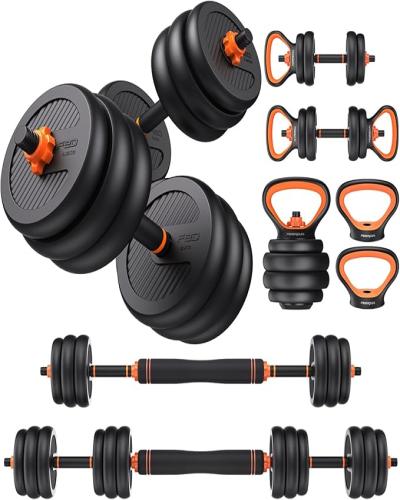
The FEIERDUN Adjustable Dumbbells 20/30/40/45/70/90 lbs is a versatile 5-in-1 free weight set designed for complete home workouts. It can be used as dumbbells, a barbell, kettlebells, push-up stands, and weight plates, offering multiple training options in one compact system. With its adjustable weight design, you can easily customize resistance to match your fitness level and progress over time. Ideal for both men and women, this space-saving set supports full-body workouts, muscle building, strength training, and overall fitness from the comfort of your home gym.
Props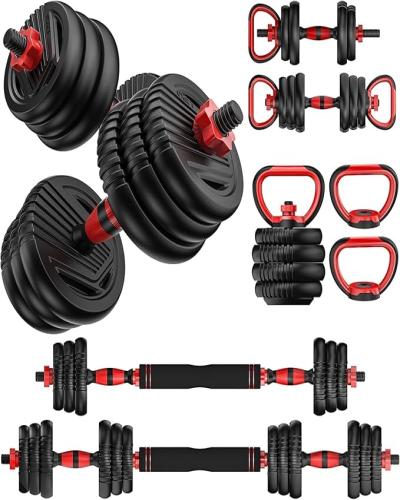
The Adjustable Dumbbells 20/30/45/70/90 lbs Free Weight Set is a versatile 5-in-1 fitness solution for home workouts. It easily converts into dumbbells, a barbell, kettlebells, and push-up stands, giving you multiple training options in one compact design.
Props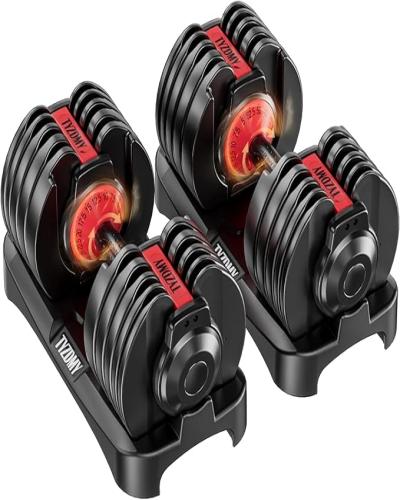
This adjustable dumbbell set includes two dumbbells with a combined total weight of 105 lbs (52.5 lbs each), offering a complete 15-in-1 strength training solution for home workouts. Designed for both men and women, it allows easy weight adjustment to match your fitness level and progression. Ideal for muscle building, toning, and full-body workouts, this compact and space-saving set is perfect for effective home gym training.
Props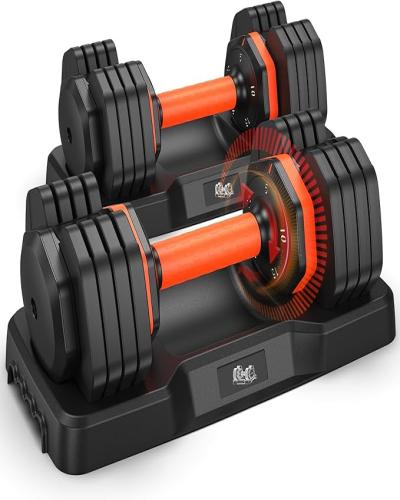
The 2026 Updated Adjustable Dumbbell Set includes a combined 110 lbs weight capacity, making it ideal for progressive strength training at home. Featuring an anti-slip silicone grip for secure handling and a convenient storage box for organization, this set is designed for both beginners and experienced users. Suitable for men and women, it supports muscle building, toning, and full-body workouts in a compact, space-saving design.
Props
Windows are a major source of heat loss in winter and cold air loss in summer, and by installing newer models with double-paned glass and special spectrally selective coatings that let in light but not heat, you can reduce heat gain inside your home during the summer months. You can also buy rolls of heat-blocking window film if you’d prefer not to overhaul every window in the house.
If your windows and doors are prone to drafts, it means the good, cold air your AC or heat pump is cranking out is likely escaping.
Seal those cracks with weatherstripping, door seals, window insulating foam tape, caulking, or insulation. You can also compare products on the Energy Star website to find the ones that are right for you.
Finally, installing insulating window treatments, such as cellular shades, solar screens, or blinds, can help keep the sun’s heat out of your home.
When shopping for new window treatments, look for products with an AERC energy rating. AERC is an independent organization with a mission to rate, label, and certify the energy performance of window products.
Depending on the size of your home, a whole-house fan can be an excellent, low-energy solution that keeps your whole family cool in hot weather.
Prices for whole-house fans range from roughly $500 to $2,000, with additional installation costs, which are significantly lower than installing a new heat pump. Whole-house fans, which pull air in from open windows and release it through the attic and roof, also expend significantly less energy.
According to the Department of Energy, a whole-house fan costs between $.01 and $.05 per hour to run, while a single 18,000 BTU window unit air conditioner costs $.17 per hour.
Radiant barriers are a form of insulation typically installed in attics to reduce summer heat gain in the home and lower cooling costs. These barriers consist of a highly reflective material that reflects radiant heat rather than absorbing it.
When the sun heats a roof, the heat travels through the roofing materials to the attic side of the roof, warming the inside of the home. With a radiant barrier installed, radiant heat transfer from the underside of the roof to the other surfaces in the attic is minimized.
Radiant barriers are most effective in hot climates, and they're estimated to reduce cooling costs by 5% to 10%.
While most of the solutions we’ve discussed are long-term ways to cut back on your energy use and cool your home in a more sustainable way, there are actually plenty of little changes you can make on a daily basis that can add up.
Unplug electrical chargers, which generate heat, when not in use. (The same goes for small appliances and electronics, too. Video game systems, small kitchen appliances, and laptop chargers all draw energy and emit heat even when not in use.)
Replace your incandescent light bulbs with energy-saving CFLs or LEDs, which don’t emit nearly as much heat when turned on, and which reduce energy consumption (and costs) by up to 80%. (You can compare the electrical output of light bulbs on the Energy Star site, too.)
Use fans instead of the AC. While we’ve already mentioned the benefits of a whole-house fan, using a regular fan is the ideal way to cool yourself off in hot weather while saving energy at home. (In high humidity or temps over 95°F, though, you should definitely turn that air conditioner on.)
Get your green thumb going. One more thing you can do to increase the shade around your house is to grow native species of plants that will vine along your home.
While trees provide wonderful natural shade, vining plants that grow along trellises, arbors, or lattices will not just add to the curb appeal, but they’ll provide additional, fast-growing seasonal shade cover, too.